Developing scenarios with the LEGO SERIOUS PLAY methodology

September 3, 2010 in News and Events by Per Kristiansen

I will be offering this workshop as a “pre-conference” workshop to this years Pegasus Systems Thinking Conference in Boston (I will also do short workshop on conference). Here is what Pegasus write on their website (http://pegasus.prod.ifpeople.net/pre-post-conference/pre-conference-workshops):

Scenarios are carefully constructed stories about how the world around us might—not will, not should—unfold over the years ahead. Scenario thinking challenges our mindsets about what could possibly happen so that we are able to develop robust strategies in an unpredictable and uncertain context. This seemingly simple yet sophisticated tool has a solid track record in improving the quality of strategic conversations and outcomes both within organizational teams and in multi-stakeholder, cross-organizational groups. By integrating the LEGO® SERIOUS PLAY™ method into the scenario construction process, we engage more than just our heads, but also our hearts and hands, enabling us to make our thinking more explicit, the stories we create more powerful, and our actions more effective.

In this workshop, you will:

  • Be introduced to the hows and whys of scenario thinking
  • Experience the unique LEGO SERIOUS PLAY method
  • Discover the rigor and value of using the process to make scenario thinking clearer and more explicit, leading to better strategy
  • Apply these tools to your own specific strategic challenges

For more info feel free to contact me, or even better, register on the Pegasus website

Strategic Play Facilitator Training

August 21, 2010 in Generic Discussion by Jacqueline Lloyd Smith

Strategic Playroom Facilitator Training with LEGO SERIOUS PLAY methods and materials. 
The training dates for the Autum Season in Canada are:
 October 1 and 2 in Thunder Bay, Ontario, Canada
and
November 8, 9, 10 and 11,  2010 in Vancouver, British Columbia, Canada

Please visit our site for more information: www.lloydsmith.com
To register today email info@lloydsmith.com
or call +778-294-5500

Lego Serious Play Open Source Brochure

August 19, 2010 in Generic Discussion by Marko Rillo

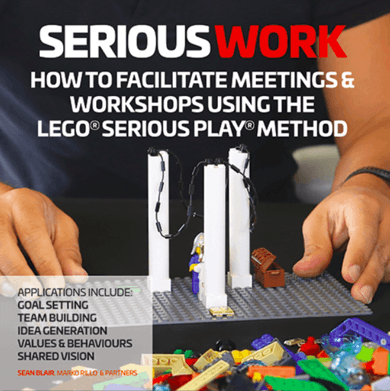
Seriousplay.com website has published Open Source document outlining the basic guiding principles of LEGO® SERIOUS PLAY® and its philosophy.

You can download it from clicking on the image. It is a large file (37 MB) and download may take some time depending on your bandwidth.

LSP Open Source Brochure

LSP Open Source Brochure

The core methodology of LSP has been transcribed and made public for people and facilitators looking to benefit from utilising this method. The Open Source document aims to empower and inspire people to become familliar with the LSP method as well as open up the experience to people who previously couldnt be a part of it.

By sharing the method of LSP, LEGO hopes to will illustrate the “power of thinking through your fingers” enabling individuals to unleash insight, inspiration and imagination, in a practical and direct way. The common language – the bricks – makes everyone equal and allows all opinions and aspects to be heard. The bricks allow people to communicate thoughts and ideas in place of traditional communication methods that can be too restrictive.

What is included in the document?
Over the past decade, the LEGO® GROUP has supported the rigorous and careful development of three types of LEGO® SERIOUS PLAY® resources:

  • The LEGO® SERIOUS PLAY® basic principles and philosophy, upon which everything else is built;
  • The LEGO® SERIOUS PLAY® materials – sets of specially selected LEGO bricks and pieces;
  • The LEGO® SERIOUS PLAY® ‘applications’ – detailed roadmaps of different workshops that make use of the principles, the philosophy and the materials;

In the past all three of these were only available to trained and certified consultants. From June 2010 however, the first two of these have been made ‘open source’. This document outlines the basic principles and philosophy, and the LEGO® SERIOUS PLAY® boxes (large sets of LEGO bricks and pieces) can be found here on the LEGO® SERIOUS PLAY® website under the products section.

The document does not include detailed applications, because LEGO® SERIOUS PLAY® is entering a new phase. New applications will be developed by the international community of users, and may be shared online. In this new phase welcome creative uses of the tools, and innovation in the community.

LSP Community-Building Workshop

August 5, 2010 in News and Events by Eli De Friend

As many of you know, the first open LSP Community of Practice workshop is being held in Switzerland on 27-28 September 2010. It is already listed in the Events section of this web site; however, many of you may not have noticed or received the June 29th email that was sent out by Helle Friberg of LEGO.

The objective of this workshop is to follow-up on a number of questions raised in Billund in April 2010, including:

  • Purpose and Scope of the Community or Communities of Practice
  • Rules of the Game; Operating Principles

If anyone (particulary those of you who will not be able to attend in person) would like to submit additional suggestions for the agenda, please feel free to do so. Denise Meyerson has already  suggested setting up a video-conference via Skype to provide an interactive medium with interested parties who are unable to attend. We are looking into the technical feasibility of this.

We have reserved a workshop room for 2 days ( September 27-28) at the Hotel Mövenpick in Lausanne, right next to IMD . CAPRESE will cover the cost for renting the room, as we recognise that you will be covering the cost of your flights and accommodation. We propose to share the cost of refreshments and lunch and will come back to you nearer the time with some ideas for the catering.

If you are interested in participating and have not yet done so, please inform me (Eli De Friend). Please organise your own accommodation (we can provide suggestions). For the logistics, it would help to eventually know where you have chosen to stay.

In the meantime, wishing you all a lovely summer.

Training in Designing and Facilitation with the LEGO SERIOUS PLAY materials and methodology

August 3, 2010 in News and Events by Denise Meyerson

For the first time in South Africa!  I will be delivering a 2 day introductory program on the 30 and 31 August in Johannesburg, South Africa.  Please email denise.meyerson@mci.edu.au for more details.

Research Documents the Value of LEGO SERIOUS PLAY in Real Time

August 2, 2010 in Serious Play Research by Robert Rasmussen

The design of the LEGO SERIOUS PLAY process is based on an extensive body of research on how people, especially adults, learn and how they communicate. New and emerging research is documenting the real-time value of LSP in a variety of workplace settings. A three-year study of ways to improve group dynamics in multidisciplinary design teams at the early stages of innovation documents a number of successful applications of LSP within project design teams and between the design team and stakeholders and users. This research was designed and led by Louise Møller Nielsen and the Department of Art and Design at Aalborg University in Denmark.

Louise Moller Nielsen

Louise Moller Nielsen

Almost all teams begin projects in high spirits and with high expectations. At the first deadline or milestone, spirit and enthusiasm dampen or completely disappears when it becomes clear that there is a gap between expectations and accomplishments. Are there innovative processes to reduce this gap at the early stages of innovation? The purpose of Nielson’s research project was to document the ability of artifacts (LSP constructions) to (1) stimulate conversation within the team and between the team and project stakeholders and (2) create shared frames of reference within the team at the early stages of innovation.

This three-year research project documents the ability of LSP workshops to increase conversation and establish a shared language for project teams ranging from the team changed with designing the next generation of guitar to teams responsible for improving ground support set-up for early stage disaster relief. The study group included traditional manufacturing organizations (such as Daimler) and social service agencies (such as the Red Cross). Louise Møller finds that a team meeting is less successful when the participants “leave the concrete matter (the bricks) on the table in favor of a more typical meeting-style discussion. This (conversation based process) induced longer dialogues and arguments, with fewer participants involved in the discussion.”

In sharp contrast, when team members grounded their conversations by referring to their LSP models, “there was a more rapid dialogue, which included all the participants at all times. Sometimes, it was even as if the critical decisions were formalized by a consensus assurance in the group, and subsequently the shared model was not altered, until all participants around the table had given their acceptance of the change.”

Download the PhD Dissertation of Louise Moller Nielsen (2009) Personal and Shared Experiential Concepts

Playing for Survival

July 31, 2010 in Generic Discussion by Jacqueline Lloyd Smith

Playing for Survival

In his book “Play: How it Shapes the Brain, Opens the Imagination and Invigorates the Soul”, Stuart Brown, M.D., explains that not only have scientist proven that play is needed and used within the animal kingdom for survival, but that play allows the player to gain new insights, test new behaviours, and develop new strategies. John Byers, an animal play scholar speculates that during play our brain is actually making sense of itself though simulation and testing. In landmark research conducted by Marian Diamond in 1960, concluded that play has an important role in brain development, and it is not just the act of playing but the interaction of playing with ideas within an enriched environment, that term enriched environment speaks to the interplay between people and ideas.

Diamond discovered play is one of the most advanced methods that nature has developed for the complex brain to create itself.  Within the business world, play allows us the opportunity to imagine new possibilities and situations that never existed before, and most importantly can create to make the future better. This occurs during the process of play as the brain experiences rapid growth and neurons connect, disconnect and reconnect as the brain organizes information and learns.  The process of play helps the brain to develop and prepare for the unexpected and create conscious and subconscious contingency plans that are agile and ready to adapt to the changing business landscape.

In today’s business world the idea of play for plays sake or for developing strategic thinking is not really acceptable. The game of golf, which is a stage of play called “games with rules”, has been referred to as the “green corporate board room” and this does seem to be an acceptable way for adult business people to play.  After spending four hours together they can assess if their colleague cheats or embellishes and the players may emerge with a new sense of who the other player is based on their interpretation or respect for the rules.

But when we dig deeper into an element of play which is referred to as “making things” we can see many inventions that we use today actually came from the pure act of play.  The airplane and the steam engine were first toys, and wind-up toys lead to the development of the clock.  Fireworks came before the cannon and so we can see the act of playing with things for amusement has often lead to the development of useful things.

It is also clear the brain can not benefit from play when it’s faced with immediate danger and must react in order to survive.  So it is also clear for strategic play to work and be of great benefit, organizations must build play and playful opportunities into their daily activities, systems and processes.  And for play to be of maximum benefit, scenarios must be tested randomly – there is no point for the manager to play out a situation that he has already experienced and has decided upon the answer or path forward. In fact the randomness of play is needed for full maximum learning and as such the Strategic Play™ facilitator leads the players through a process needed to fully maximize from the benefits of workplace play.

These are some reasons why Lloyd Smith Solutions (www.lloydsmith.com) uses Strategic Play™ and why we see the value of play at work – this is the beginning of a play movement and we will continue to bring new ideas to this blog that we can all play with together.  You can also visit www.strategicplayroom.com to join additional conversations.

Play is All We Do – All We Do is Play

July 26, 2010 in Generic Discussion by Madis Talmar

I recently came across an interesting chain of thought derived from a compatriot of ours Andrus Laansalu (Estonia) which to my mind can add value to LEGO® SERIOUS PLAY™ reasoning quite well. See if this makes any sense to you:

Even though this could be started from further away in a more abstract dimension, I decided to begin with The Big Bang.

We all know that from the time of the Big Bang, particles have been floating around in space. At first the universe consisted of mainly hydrogen but as cosmic objects emerged and later collapsed, temperatures starting from 9 million degrees enabled several hydrogen atoms to merge and create new elements and then again new ones: indeed all the elements in the universe seem to have been created in either a supernova explosion or just the natural burning process of the stars.

The inherent design principle of matter is therefore in its essence of combinatoric kind. Lower elements merge into higher ones, atoms then constitute molecules, molecules materials and materials can be combined into things. Rather a straightforward logic which we are surely all familiar with.

Similarly if we observe evolution in nature, we come across essentially the same design principle: every living thing is a product of a chain of combinations that can in theory be tracked back some 4 billion years to the very first traces of life. Genetic information has been combined together to try to overcome external and internal obstacles for all that time and the combinations that have worked, have survived. The same logic that works in the universe, is therefore fully usable in the living things as well.

It seems however, that biological evolution is not where this chain ends as the combining of different things is fully embedded in yet another level – our thinking appears to work on the notion of combinatorics just as well. Taking icons, indices and symbols and putting them together in our mind, we construct the world around us. All people are therefore playing with different pieces of the World at all times because that is the only way we can get by. So not only is our brain hardwired for play, it is hardwired for nothing but play.

Mr. Laansalu continues his speech by saying that no person is therefore superior to any other because we are all always combinators (i.e. we are players!) and it is just the arsenal that is different for each profession, but that is getting out of our focus.

What I derive from all this is that Lego® therefore seems to be one of the purest forms of reality that takes use of the only technique for living we do know – and that is playing. Whether this competes with the other explanations to why might Lego® be a good tool to use at serious processes, I guess time will tell. But it sounds promising.

The Value of Play for any Company or Team

July 23, 2010 in Generic Discussion by Jacqueline Lloyd Smith

For years many innovative management consultants, who pondered the value of play within organizations, conducted their work in isolation.  After all, the idea of ‘play at work’ in Western society seemed a bit eccentric and not widely valued.  However, when a handful of consultants met in Denmark in 2006, and began to collaborate, we recognized that we are seeing patters emerging globally.    Collectively, we have identified that not only are business situations becoming more complex but that the old systems that people have depended upon for years are not only out of date, but are actually doomed for failure.  Many organizations continue to insist that old successful patters will continue to bring the same results.  They might be right as we cannot see into the future. But it is more likely that change has occurred slowly and insidiously over time taking them off guard. Due to past successes these organizations may not yet be uncomfortable enough to change. Those that have recognized that their old approach will now sabotage their future success, come to us open to try a new approach.

The new approach is one that we call Strategic Play.  It comes from a basic premise that we are all hardwired for play.  For managers to be able to successfully adapt in a changing business world they need to be able to engage their imaginations and play with ideas in a place that is safe.  In this way play allows the player to have a type of dress rehearsal and prepare for the subtleties of the changing business environment and function comfortably with ambiguity.  Within the Strategic Playroom everyone on the team can test out a theory, a hunch or a tried and true method and see if it will continue to bring successful results without putting their reputation or companies assets on the line. They can gather information from scenario testing that can be adjusted, built upon, or scraped all together without doing any damage. But at the same rate through play their imagination can form new cognitive combinations that will likely develop an innovative idea.  The team can then spring board into the next combination of ideas bringing great clarity to the situation. In a playful approach, nothing is lost but only gained and the team leaves the Strategic Playroom feeling engaged, activated and focused with an accurate shared mental model.

Keep in mind, what we do is not just play for play sake, as we use applied systematic creative play.  The activities are lead by a trained creative facilitator that sets both the stage and the rules of engagement.  The play is focused and structured enough with developed etiquettes that create the layers needed for building blocks that take the player into deeper and deeper levels where the brain continues to function at both conscious and subconscious levels. It is through this process that the participants emerge with new insights. These insights may bring immediate actionable items or may percolate as the neurons within the brain connect, get tested and then sometimes break away and reconnect getting stronger and ready to put ideas into action, ready when the situation changes.

 The fact that people enjoy the process of strategic play so much that they loose track of time is not just an accident, it is built into the approach.  When we find ourselves fully in the zone, this is the state that psychologist Mihaly Csikszentmihalyi called “flow” or the “flow zone”.  This zone allows for the brain to think better and faster.

Research indicates that those who engage in this process of play are not only better able to problem solve but they are actually developing a higher social IQ.  It’s clear in the changing world, and specifically for business a changing global economic environment, those who are able to “think quickly and respond strategically” are in demand over those who are just able to “do”.

We see the value of play at work – there are many more posting to come,  so please stay tuned and we will continue to bring new ideas to this blog that we can all play with together.

Impact of Open Source to Your Business

June 30, 2010 in Generic Discussion by Marko Rillo

When LEGO informed the former licensed partners about their plans to “go open source” with LEGO® SERIOUS PLAY™ methodology – most of us did not have a faintest idea what this would mean to our activities.

Obviously – setting up from scratch a new community to deal with training activities of the future facilitators, building its backoffice, setting up technological platform, handling its internal communication and member management is already a challenge that we need to face during the coming months and even years.

But so far we have had to deal with petty practicalities that are despite their pettiness sometimes rather cumbersome and time consuming. Hence – two months down the line, can you comment about the extent of change that the recent changes have had upon your business:

  • How much you have had to upgrade your marketing materials: websites, sales brochures, handouts, slides.
  • How have you adapted to new ordering system via LEGO Shipping & Handling (incl. some of us – how have you solved the situation that your country might no longer be supported as a delivery destination).
  • Etc.

Can you share your experiences and lessons learned at our group forum page … how have you managed so far?