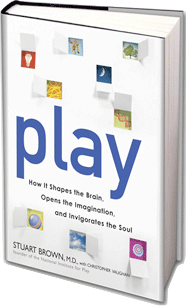
Stuart Brown. Play: How It Shapes the Brain, Opens the Imagination, and Invigorates the Soul
A few months ago when I was doing my preparations for TEDxTartu talk about play@work I started reviewing popular sources for materials that cover connections between playfulness and work. I found out vast literature. In two extremes mostly – either related to developmental psychology or about (what Plato calls) “frivolous play”: play as a pastime. However, direct of play@work linkages were few.
One of them was written by Stuart Brown, founder of the National Institute for Play, co-authored with Christopher Vaughan. The book is called “Play: How It Shapes the Brain, Opens the Imagination, and Invigorates the Soul”.
The book starts with background on animals at play. First vivid example describes an incident where an encounter between polar bear and a husky did not end up tragically for the latter. Instead hungry polar bear was happy to be drawn into puppy-like play.
What follows is an interesting thought experiment that spans several pages. Play is considered to be one of the most important means of child and adult learning; one of the most important sources of creativity; playing together as a fundamental basis for bonding and teamwork. Numerous examples presented in the book demonstrate that our species has been produced to play throughout the adulthood.
Why on the earth do we consider that in order to be productive we need to be sombre and serious at work? Apparently this is an outdated view. There are several studies that demonstrate that playfulness at work is in fact increasing our productiveness.
Indeed – even joking sometimes helps in certain conditions as Lancaster professor David L. Collinson has found in his studies[1]. Side remark – this does not obviously mean that we ought to start joking and playing all day. Certain modesty should be exercised – thinking of some light-hearted solitaire addicts.
However, the most important statement of this about play@work comes from medical studies. These have identified that very serious workplaces are not necessarily more productive. But they certainly are much more depressive. So the opposite of play is not work, it’s depression.
Lots of books about play tend to take playfulness out. Brown is not one of them. His book is fun to read. My definite reading recommendation for anybody interested in how to incite some playfulness in your office or factory. If you are interested then I also welcome you to watch his inspiring video at Serious Play TED conference called “Play is more than fun”.
[1] Collinson (2002) Managing Humour. Journal of Management Studies 39:3, pp. 269-288.
Recent Comments