Harkness Table and LSP: Differences and similarities

February 11, 2013 in Serious Play Research

Harkness Table

The Harkness Table

I was reflecting on my experience with architecture students at University of Ferrara and LEGO SERIOUS PLAY. [See the video]

I find amazing how students who did not have any clue about the content and the goals of the workshop engaged in the discussion and raised a number of enlightening ideas about Heritage. They were not asked, neither provided, any books or papers to read, the idea was to understand how a bunch of students in their early-twenties could theorise and think about Heritage independently, critically andcollectively.

So, in my research about educative approaches that capitalise on collaboration and collaborative meaning-making, I’ve found about the Harkness Table. For those who are not familiar with it, this is an educative approach introduced in 1931 when Edward Harkness, a philanthropist, challenged Exeter University asking them to innovate education and provided them with an oval table. The idea behind the table, which was meant to allow 12/15 students to sit around together with their teacher, was to create a different approach to education where students were seen as a team and could be encouraged to take part to a discussion, interact and learn about collaborative practices, by reducing the influence of the teacher.

The idea of a class as a team  that capitalises on teamwork and encourages interaction among students in a free environment sounded a pretty close approach to that I adopted. The Harkness Table focuses a lot on these concepts, and I’ve found it thrilling. Though the more I read about it, the more the differences emerged.

Read the rest of this entry →

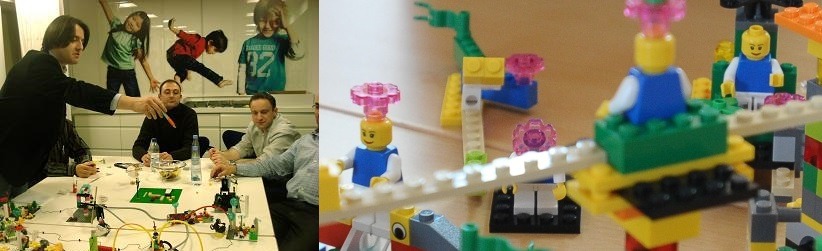
Serious Play™ for 85 people at European Innovation Academy

February 7, 2013 in Serious Play Case Studies

This post gives a quick overview and lessons learned from the 22nd January 2013 session with Legos we had at the European Innovation Academy (at Tallinn University of Technology).

Participants: 85 (mainly second cycle students, 25+ nationalities) divided into 9 startup teams
Session length: 90 minutes
Primary goal: that team-members unify understanding of their own startup concept
Facilitator: Madis Talmar
LEGO sets used: variety of educational boxes (also Duplo) mixed with characters and metaphoric elements

General timeline This winter the European Innovation Academy event decided to kick it up a notch for their participants and bring in some LEGOs to provide participants with an interesting new experience. Good decision on their behalf, no doubt! For the facilitator, however, this posed quite a challenge as the task entailed 1) getting people acquainted with the Serious Play method, 2) assigning a personal task to every team (of 9) depending on their current development level, dividing the time to individual and team efforts, and 3) having each team present their common vision to the others.

Getting started As time was an important constraint, we got to the business end of the session quite quickly (12-13 minutes). To set the pace, I used two short exercises: 1) building a duck, and 2) building a tower and then turning it into a bridge. These worked out rather well despite the quite unfavorable setting of the room.

Lesson #1 By unfavorable setting of the room I mean the following: we were forced to do the session standing up, each team at their own table where the LEGOs had been put into a large pile. As a lesson learned, I would advise against that setting, especially the standing part because the view of the facilitator is seriously blocked and some teams are bound to pay less attention to you. I’m a big guy but it took some effort to keep people away from making a lot of noise during the intervals.

We were also forced to use a big pile of LEGOs as LEGO had a major order time for Starter Kits so we didn’t quite have enough. I feared that would be a problem but it was much less so as people were able to combine the pieces very creatively despite the mess on the table.

Proceeding For the first part of the central task, each individual had to build their understanding of the key components to their startup (7 minutes). Each person then had 3 minutes to present their view and answer questions. Finally, the teams moved towards a common understanding by combining elements on the run and presenting the whole view to others.

Lesson #2 With young active people, it seems that everyone wants to express their points. I planned for some example presentations by some teams but during the session every single team went for the mic so we changed the course of the session to allow everyone to present their startup. So I know now that under some circumstances one must be prepared to extend that part to accommodate for the drive to express oneself.

Lesson #3 Considering that each team had a very limited time to find their commonalities, everyone took a really great job. Many teams were able to identify a number of aspects about their business they had not included before so a time structure 7+3+15 (individual work + explaining individual work + finding commonalities) was quite sufficient for the particular task.

Finalizing We ended the session with presentations and then a round of applause to celebrate for the creativity in the room and the progress each team made.

A few more points to stress
1) although continuous playing is the ideal, everyone needs to hear the task clearly so it’s a good idea to ask everyone to step away from the table for the time of giving tasks
2) I tried giving a choice of two different tasks depending on the development level of each startup but that approach proved to be too confusing. if possible, I’d stick to one central task only and no variations to it
3) When there are a lot of people in a session, moving around and continuously double-checking if the task is understood and everyone involved becomes crucial. I ended up including many people into discussions and elaborating on the proceeding to almost all tables due to the different approaches taken by the table and the different startup profiles

Overall score to the session 8/10

Hope this helps when you also have a large session to run and the time is very limited. Let me know if any questions! Thanks for reading

LEGO Idea Conference and Facilitator Meeting

January 16, 2013 in Generic Discussion, News and Events

As was the case in 2012, the LEGO Foundation has kindly extended an invitation to the LEGO SERIOUS PLAY community for the annual Idea Conference. This year’s conference is on April 9th, and as the traditions prescribes in Billund, Denmark. The 2013 theme is “Play to Create”

The invitation goes to those of you, who are trained and certified LEGO SERIOUS PLAY facilitators – either by LEGO before April 2010 or after by a master trainer delivering a certification at a similar level as LEGO did before the open source was implemented.
In combination with the Idea Conference we will arrange an events for the LSP participants: On Sunday 7th we will be looking at doing one or more hands-on processes, and on Monday 8th we will follow a program similar to last year, i.e presentations of case/application examples, and an open-source process where we will discuss what ever topics emerge

For the case/application examples, and for hands-on topics, we would welcome any ideas.
Participation in the LEGO Idea Conference requires registration. You do that by downloading the registration form (reg-form 2013) and emailing it to Per Kristiansen or Robert Rasmussen. We will then send you a confirmation with any further details. In the event the interest is higher than the number of invitations, the first registered will be selected.

Participation in the Idea Conference and the “LSP facilitator meeting” is free of charge. You pay for your own travel, food and accommodation.

Looking forweard to hearing from you

Per Kristiansen and Robert Rasmussen

About the LEGO IDEA Conference:
For the last six years, the LEGO Idea House and The LEGO Foundation have jointly hosted the annual LEGO Idea Conference in Billund, Denmark. Through a horizon-broadening program featuring ‘Hands-On, Minds-On workshops, this one-day event shows how the LEGO brand is so much more than a toy brand.

Certification Training in Spanish – Training Calendar for 2013

January 4, 2013 in News and Events

Lucio Margulis and Robert Rasmussen at a Facilitator Training

Calendario 2013 para la Formación de Facilitadores en Espanol de la Metodologia y las Herramientas de Lego© Serious Play™

Nuevas Fechas para el 2013 en México, Latinoamérica y España para la Formación en Español de Facilitadores de la Metodología y las Herramientas de LEGO®SERIOUS PLAY™

Nuevas Fechas y Lugares para la Formación de Facilitadores organizada por Rasmussen Consulting y Juego Serio™.

T3 Programa de Formación de Facilitadores de la Metodología y las Herramientas de LEGO© SERIOUS PLAY™

  • Brazil 18 al 21 de Marzo de 2013
  • Barcelona – 15 al 19 de Abril de 2013

México:

  • Primera Fecha – 4 de Mayo al 7 de Mayo de 2013
  • Segunda Fecha- 10 al 14 de Junio de 2013
  • Tercera Fecha- 2 al 5 de Septiembre de 2013
  • Argentina, Chile o Uruguay -El lugar final será decidido a mediados del 2013 - 11 al 14 de Noviembre

Por información enviar un mail a info@juegoserio.com

Lucio Margulis

Formación en Español con soporte en inglés.

Para más información visitar:

http://www.rasmussenconsulting.dk/facilitator-training-calendar/

http://seriousplaypro.com/2012/10/13/2013-schedule-for-facilitator-certification-programs-in-the-lego-serious-play-method/

http://www.luciomargulis.com.ar/?p=152

Read the rest of this entry →

An LSP workshop with Architects-to-be

December 31, 2012 in Serious Play Videos

Architects and Heritage: a LEGO® SERIOUS PLAY® Workshop

The Video is a clip taken from one of the LEGO SERIOUS PLAY workshop I run at the University of Ferrara, Faculty of Architecture in November 2012.

Students taking part to the workshop are currently working on a course project on Heritage; their main focus is Ahmedabad Heritage Walk (India). The aim of the workshop was to create a team out of the group of individuals working together and to lay the foundations for their collective work. To achieve this students engaged in a classic LSP workshop: they were first asked to define what Heritage is by building an individual LEGO model of their personal concept. Each student built their own vision and shared it with others. Sharing individual models and ideas let differences emerge: it came out that though they were all working and researching around the same topic, their individual perceptions, their focus, their ideas were very different: some students focused on the time dimension, others have seen heritage as coming from a relationship between present and past, others have highlighted the confusion and chaotic dimension related to the idea of Heritage, and others focused on the subjects who perceive, define and socially construct the concept of Heritage.

A number of bright ideas had been discussed by the students in the three hours length workshop and at the end they were asked to build a shared model: after each of them presented their personal idea, after discussing and investigating the individual models, the group was asked to become a team by building a single shared model.

Students have taken their individual models, have negotiated their visions, their ideas, their concepts and they come out with a new model. The new model is simply a shared knowledge literally constructed and agreed by all participants and that final model represents the new roadmap of their project.

A big thank you to the Faculty of Architecture at University of Ferrara, to the professors and students who allowed this experience and who engaged in this experience.

[Source: www.legoviews.com]

Architects’ challenge: Building ideas with LEGO bricks!

December 19, 2012 in Serious Play Case Studies

Ville Savoy (Le Corbusier) realised with LEGO Architecture

Ville Savoy (Le Corbusier) realised with LEGO Architecture

LEGO bricks to discover more about architecture and about architects’ mind and perception of reality. [from: Paesaggio Urbano 5-6/2012]

The relation between LEGO and Architecture is a longstanding one: as a response to the increasing attention to modern architecture in early 1960s, LEGO developed Scale LEGO with the ambition that architects and engineers would attempt scaling their models using LEGO.

But the relationship between Architecture and LEGO can go far beyond this historical link created by LEGO itself and it comes from a creative approach based on constructionist theories which have been developed in the 60s by Seymur Papert. Papert was among the first ones to adopt LEGO bricks as a learning tool in education and he capitalised on the strict relationship between hands and brain: it is well-know that hands are connected to between 70-80% of our brain cells, which means that through the exploitation of this neural connection people can learn and think more and in more creative ways by connecting their hands with their brain and by constructing something material. This is the assumption which lead in late ‘90s to the development of LEGO SERIOUS PLAY [LSP] a method used in organisations to help people to think, share ideas and creating teams, solve problems and define organisational strategies.

Read the rest of this entry →

2013 Schedule for Facilitator Certification Programs in the LEGO® SERIOUS PLAY® method

October 13, 2012 in News and Events

The objectives with our facilitator training program in the LEGO SERIOUS PLAY method  is to provide the facilitator with the skills, practice, theoretical background combined with the confidence and commitment necessary to successfully prepare and facilitate the workshops in a way that gives maximum value to the participants. The facilitators ability to first design the workshop and afterwards delivery the workshop is essential achieve success with the methodology.

2013 training schedule – latest update April 3, 2013
Note: More sessions might be added for the second half of 2013

Spain, Barcelona, April 15 – April 18 (training in Spanish with support in English)
UK, London, April 23 – April 26
Denmark, Odense, April 29 – May 2
Mexico, Mexico City,  May 4 – May 7 (training in Spanish with support in English)
United States, Boston, June 3 – June 6
Singapore, Singapore, July 9 – July 12
Mexico, Mexico City, June 29 – July 2 (training in English with support in Spanish)
Netherlands, Twente, October 2 – 5
United States, October October 14 – 17. Venue still to be decided
Argentina, Chile or Uruguay, Nov. 11 – Nov. 14 (place to tbd by spring 2013) *
Denmark, Copenhagen, Dec. 9 – Dec. 12 arranged in collaboration with Per Kristiansen

Training sessions in Spanish is arranged in cooperation between Rasmussen Consulting and Juego Serio.

The training content is identical for all sessions. The curriculum and manuals meet the standards set by the Association of Master Trainers in the LEGO SERIOUS PLAY methodology on the initiative of Per Kristiansen and Robert Rasmussen. Facilitators will receive document of qualification upon completion of the training.

For more details please contact me by email: robert@rasmussenconsulting.dk or skype: lego_serious_play
You can always check out the fully up-to-date schedule on www.rasmussenconsulting.dk 

Facilitator Certification Programs in the LEGO® SERIOUS PLAY® method – Schedule for 2013 and early 2014

October 4, 2012 in News and Events, Training and Certification

2013 LEGO SERIOUS PLAY training programs:

The LEGO® SERIOUS PLAY® method is a facilitated process, the impact of workshops based on the method are, consequently, directly tied to the quality of the facilitation.

Therefore, the purpose with our facilitator training program is to provide the facilitator with the insights, confidence and commitment necessary to successfully prepare and facilitate the workshops in a way that gives maximum value to the end-user and has lasting impact.

2013 Programs:

January 21-24th in Mexico City, Mexico: Stage 1 and Stage 2 (with full support in Spanish)
February 25-28th in London, England: Stage 1 and Stage 2
March 11-14th in Barcelona, Spain: Stage 1 and Stage 2 (with full support in Spanish)
May 20-23rd in Mexico City, Mexico: Stage 1 and Stage 2 (with full support in Spanish)
June 3-6th in Amsterdam, The Netherlands: Stage 1 and Stage 2
June 14-17th in Bogota, Colombia: Stage 1 and Stage 2 (with full support in Spanish)
August 19-22nd in Santiago, Chile: Stage 1 and Stage 2
September 9-12th in Los Angeles, US: Stage 1 and Stage 2
October 7-10th in Mexico City, Mexico: Stage 1 and Stage 2 (with full support in Spanish)
November 4-7th in Amsterdam, The Netherlands: Stage 1 and Stage 2
December 9-12th in Copenhagen, Denmark: Stage 1 and Stage 2 (offered in collaboration with Robert Rasmussen)

2014 Programs
January 27-30th in Mexico City, Mexico, Stage 1 and Stage 2
February 17-20th in Seoul, South Korea: Stage 1 and Stage 2

We will be following the updated program and use the new full facilitator manual developed by Robert Rasmussen and myself. The program meets the standards set by the Association of Master Trainers in the LEGO SERIOUS PLAY methodology.

Stage 1 gives a strong introduction to the method and how to use it with teams in personal relations. Stage 2 gives an advanced training in the method and on how to use if or business and organisational development.

For more details please feel free to contact me by email (per.kristiansen@trivium.dk) or direct message via my profile on seriousplaypro.com

New Products

October 2, 2012 in Generic Discussion

UPDATE: The kits are now in the warehouse, BUT they are not available yet! Reason: A number of small elements have been changed, and this means that in the LEGO set up they need to re-calculate the price (this does not necessarily mean that it will change, but it has to be checked). Hence, it may take another month before they are available. To be on safe side (!) aim for Dec 1st
Per

The Connections Kit is still scheduled for early 2013

Dear all
A quick note on products and product development. The new Identity & Landscape Kit should be ready by the end of this week, meaning that we should be able to buy it next week.

The connections kit is a couple of boxes away from being sold out (a few are left in the US). You may (again) experience that consumer service tells you that the products are discontinued and will note come back, this is NOT true and they only say so because that it what is looks like in their system. The connections kit will be back, but not until February next year, that was the earliest production slot that was available

Per

“I had no idea I knew this!”

September 24, 2012 in Generic Discussion, Pro Blog and Tweet

Several years ago I came across this article in the U.S.News. It has had a strong impact on my thinking about the power of the LEGO SERIOUS PLAY method. “According to cognitive neuroscientists, we are
“conscious of only about 5% of our cognitive activity”. If that is indeed true the vast majority of our decisions is not a conscious activity. LSP has proved to me over and over and over that is incredibly good at helping people access their unconsciously knowledge and thereby improve their decision-making. I have found that when asking people to “build a story about….” a complex issue it works very well to tell them “don’t have a meeting with yourself about what to build – just start building”. In those instances tacit knowledge emerges and people will say things like “I had no idea I knew this!”


I was recently reminded of this article, when I picked up David Eagleman’s book “INCOGNITO”. It is described as the hottest thing in neuroscience right now. It is a must read book, if you like me are fascinated by how LSP can help you build in your mind by building in the world. It is captivating and enjoyable reading.